Data Matching Example
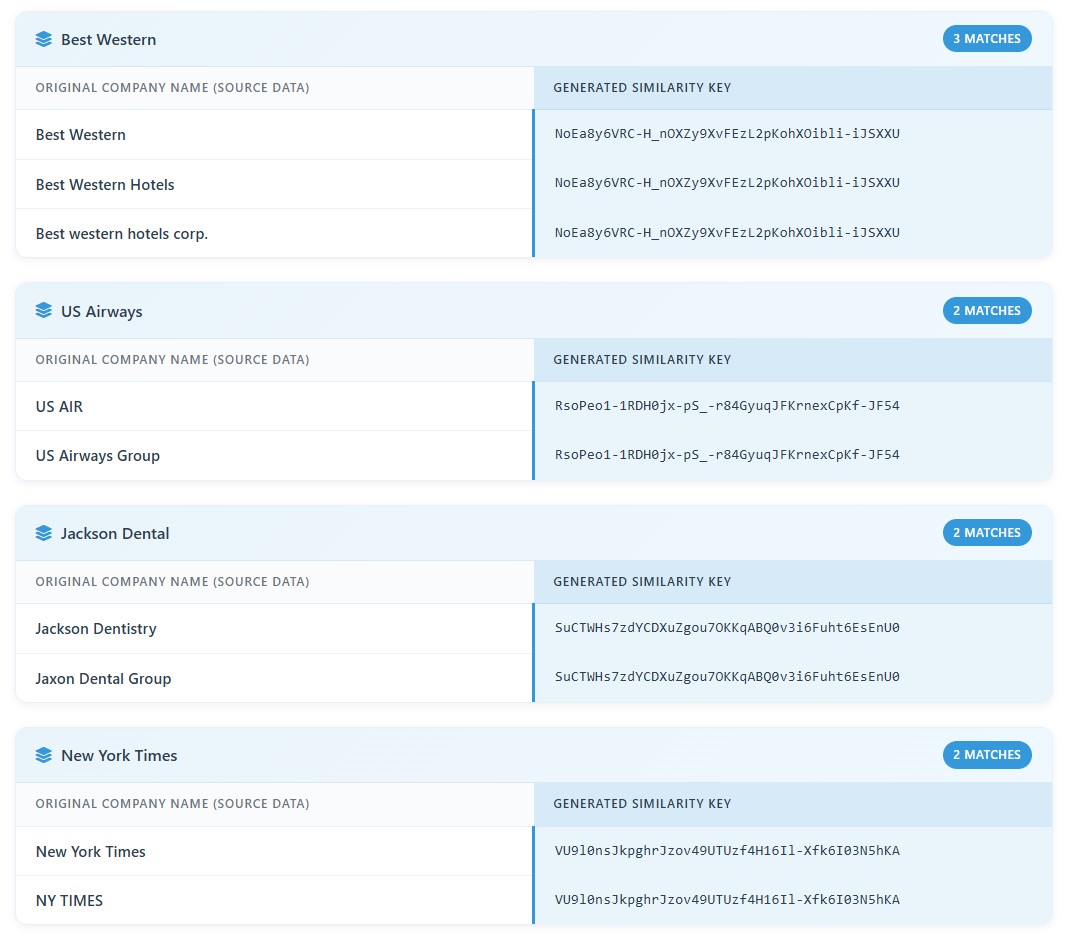
See our Databricks batch processing in action - generating similarity keys to match company/organization name data from directly within lakehouse tables.
Match organization names, individual names, addresses, and general text across entire lakehouse tables
Lightning-fast parallel processing with AI-powered similarity matching, directly against your SQL warehouse
Leverage our high-performance, parallel-processing cloud architecture to run AI-driven matching jobs against entire lakehouse tables or views, finding the duplicate and near-duplicate records that exact matching cannot.
Interzoid connects through a SQL warehouse using a personal access token, so it reads from any workspace on any cloud, whether governed by Unity Catalog or a legacy metastore.
No connector to install, no notebook to run, and nothing deployed inside your workspace. Supply a workspace hostname, a SQL warehouse HTTP path, and an access token, and Interzoid reads only the columns you select. Because the connection is HTTPS on port 443, no special outbound firewall rule is required.
Read Delta Lake tables and views directly through a SQL warehouse, governed by Unity Catalog permissions, with a dedicated read-only service principal recommended.
Learn MoreAdvanced algorithms and AI models identify similar data elements, generate similarity keys for clustering matches and detecting inconsistencies within and across your data tables.
Learn MoreMulti-threaded, high-performance architecture processes high volumes of data in seconds using our distributed cloud infrastructure.
Learn MoreGet started in minutes with our streamlined three-step process
Supply your workspace hostname, SQL warehouse HTTP path, and access token, or paste a connection string, then pick a catalog and schema.
Choose the algorithm that fits your data: organization names, individual names, addresses, general text, or a combination of two of them at once.
Receive a match report with records grouped into clusters by similarity key, ready to review, share, or load back into your lakehouse tables.
See our Databricks batch processing in action - generating similarity keys to match company/organization name data from directly within lakehouse tables.
Four data types, plus combinations that raise precision when one field alone is too broad
Resolve Acme Corp, ACME Corporation, and Acme Inc. to a single organization, across the legal suffixes, punctuation, abbreviations, and spelling variations that make company names so inconsistent.
Match James Johnston, Jim Johnston, and J. Johnston as the same person, handling nicknames, initials, middle names, and name ordering.
Reconcile 400 E Broadway St with 400 East Broadway Street, resolving directional abbreviations, street type variations, unit designations, and spacing.
Generate similarity keys for other text values, so product names, descriptions, and free-form fields cluster the same way that names and addresses do.
Require two fields to agree at once: organization with address, organization with individual name, or address with individual name. This separates the Dallas branch from the Phoenix branch while still recognizing that both spell the parent company four different ways.
Every value receives a key representing the entity behind the text rather than the characters themselves. Records sharing a key are grouped into clusters, which makes each match auditable instead of something to take on faith.
Databricks workspaces on AWS, Azure, and Google Cloud, in any region, reading through a serverless,
pro, or classic SQL warehouse. Unity Catalog workspaces and legacy hive_metastore
workspaces are both supported, as are Delta Lake tables, views, materialized views, and data shared in
through Delta Sharing.
No. Processing issues SELECT statements against the table and columns you choose and nothing else. Nothing is written, updated, or deleted, no tables are created, and no job or notebook runs in your workspace. Results are returned to your browser, and you decide what to do with them.
No. Interzoid connects directly to your SQL warehouse and reads the columns you select. There is no CSV export, no staging table, no cloud storage copy, and nothing to secure, track, or delete afterward.
The personal access token is transmitted over HTTPS with each request and is not retained after the
session ends. Because a token inherits the permissions of whoever created it, and because processing
is read-only, the recommended practice is a dedicated service principal granted only
USE CATALOG, USE SCHEMA, and SELECT, which can be revoked at
any time.
Each record processed consumes one Interzoid API credit. Trial credits are included with a new API account, so a first table can be processed at no cost, and high volume tables are supported for production workloads.
Yes. The same processing is available as a REST API that can be called from scripts, applications, and data pipelines, which allows Databricks matching jobs to be automated without using the browser wizard.
Documentation, background reading, and the rest of the Interzoid platform
Join hundreds of data teams already using Interzoid's batch processing APIs
Questions? Contact our team at support@interzoid.com